---
title: Performance analysis using pyArango Part I - ArangoDB
description: "Performance analysis using pyArango Part I: An application will persist of a set of queries on ArangoDB for one scenario..."
---
ArangoDB 3.12 Product Release Announcement! Read the blog for details. [Read Blog](https://arangodb.com/2024/03/arangodb-3-12-performance-for-all-your-data-models/)
[](https://arango.ai)
### Why Graph
[The Rise of Graph](https://arangodb.com/the-rise-of-graph/)
[The Graph ML Gamechanger](https://arangodb.com/the-graph-ml-gamechanger/)
[Consolidate to Graph](https://arangodb.com/graph-vs-relational/)
[Graph DB Basics](https://arangodb.com/graph-database/)
### Products
[Managed Graph DB](https://arangodb.com/arangograph-managedgraphdb/)
[Self-Managed Graph DB](https://arangodb.com/arangograph-selfmanaged/)
[Managed Graph ML](https://arangodb.com/managed-ml-graph/)
[Community Edition](https://arangodb.com/community-server/)
[Compare Products](https://arangodb.com/subscriptions/)
### Solutions
Use Cases
Industries
Solution Accelerators
- [Cyber/Threat Mgmt](https://arangodb.com/solutions/use-cases/cyber-threat-management/)
- [Fraud Detection](https://arangodb.com/solutions/use-cases/fraud-detections/)
- [Supply Chain](https://arangodb.com/solutions/use-cases/supply-chain/)
- [Network Asset Management](https://arangodb.com/solutions/use-cases/network-asset-management/)
- [Customer & Patient 360](https://blog.arangodb.com/solutions/use-case/customer-and-patient-360/)
- [Recommendations](https://arangodb.com/solutions/use-cases/recommendations/)
- [Case Management](https://blog.arangodb.com/solutions/use-case/case-management/)
- [Geospatial Analysis](https://arangodb.com/solutions/use-cases/geospatial/)
- [Master Data Mgmt](https://arangodb.com/solutions/use-cases/master-data-management/)
- [Software & Technology](https://arangodb.com/arangodb-for-software-tech/)
- [Financial Services](https://arangodb.com/arangodb-for-financial-services/)
- [Tele Communication](https://arangodb.com/telecommunications-and-network/)
- [E-commerce](https://arangodb.com/arangodb-for-e-commerce/)
- [Healthcare](https://arangodb.com/arangodb-for-healthcare/)
- [Government](https://arangodb.com/arangodb-for-government/)
- [Aerospace & Defence](https://arangodb.com/arangodb-for-aerospace-defense/)
- [Manufacturing](https://arangodb.com/arangodb-for-manufacturing/)
- [Enterprise Knowledge Graphs](https://arangodb.com/resources/white-papers/enterprise-knowledge-graphs/)
- [Entity Resolution](https://arangodb.com/entity-resolution/)
- [Traceability/Lineage](https://arangodb.com/traceability-and-lineage/)
- [Contexual Relevance](https://arangodb.com/contextual-relevance/)
### Developers
Capabilities
Integrations
Differentiators
- [Graph Traversals](https://arangodb.com/graph-traversals/)
- [Multi-Model DB](https://arangodb.com/multi-model-db/)
- [LLM + Knowledge Graph](https://arangodb.com/llm-knowledge-graph/)
- [Graph ML](https://arangodb.com/managed-ml-graph/)
- [Advanced Geospatial](https://arangodb.com/advanced-geospatial/)
- [Document Store](https://arangodb.com/document-store/)
- [Search Engine](https://arangodb.com/full-text-search-engine/)
- [Security & Compliance](https://arangodb.com/security/)
- [Data Masking](https://arangodb.com/Data-masking/)
- [Key/Value DB](https://arangodb.com/integrated-key-value-support/)
- [Clients / Languages](https://arangodb.com/clients-languages/)
- [BI Tools](https://arangodb.com/bi-tools-support/)
- [Containers](https://arangodb.com/container-support/)
- [Community driven](https://arangodb.com/community-driven/)
- [Model Flexibility](https://arangodb.com/model-flexibility/)
- [Graph Scalability](https://arangodb.com/graph-scalability/)
- [Performance at Scale](https://arangodb.com/performance-at-scale/)
- [Highest Availability](https://arangodb.com/highest-availability/)
- [Unified Query Language](https://arangodb.com/unified-query-languageaql/)
- [Graph + Native Document](https://arangodb.com/graph-document/)
- [Graph + Native Search](https://arangodb.com/graph-search/)
- [Cost Effective](https://arangodb.com/cost-effective-development-operation/)
- [Full Geospatial](https://arangodb.com/full-geospatial/)
### Customers
[All Case Studies](https://arangodb.com/solutions/solutions-customers/#all)
[Government & Cyber](https://arangodb.com/solutions/solutions-customers/#Government-Cyber)
[Manufacturing & Supply Chain](https://arangodb.com/solutions/solutions-customers/#Manufacturing-Supply-Chain)
[Healthcare & Science](https://arangodb.com/solutions/solutions-customers/#Healthcare-Science)
[Retail & Commerce](https://arangodb.com/solutions/solutions-customers/#Retail-Commerce)
[Technology](https://arangodb.com/solutions/solutions-customers/#Technology)
[Education](https://arangodb.com/solutions/solutions-customers/#Education)
[Telco](https://arangodb.com/solutions/solutions-customers/#Telco)
[Financial Services](https://arangodb.com/solutions/solutions-customers/#Financial-Services)
### Learn
[Documentation](https://docs.arangodb.com/stable/)
[Developer Hub](https://developer.arangodb.com/)
[ArangoDB University](https://university.arangodb.com/)
[Blog](https://arangodb.com/blog/)
[Certification](https://arangodb.com/learn/certification/)
[Community](https://arangodb.com/community/)
[Events](https://arangodb.com/events/)
[Resources](https://arangodb.com/resources/)
[Training Center](https://arangodb.com/learn/)
### Company
[About Us](https://arangodb.com/about-us/)
[Team](https://arangodb.com/about-arangodb/)
[Partners](https://arangodb.com/partners/)
[News](https://arangodb.com/news/)
[Careers](https://arangodb.applytojob.com/apply)
### Pricing
- Why Graph
- [The Rise of Graph](https://arangodb.com/the-rise-of-graph/)
- [The Graph ML Gamechanger](https://arangodb.com/the-graph-ml-gamechanger/)
- [Consolidate to Graph](https://arangodb.com/graph-vs-relational/)
- [Graph DB Basics](https://arangodb.com/graph-database/)
- Products
- [Managed Graph DB](https://arangodb.com/arangograph-managedgraphdb/)
- [Self-Managed Graph DB](https://arangodb.com/arangograph-selfmanaged/)
- [Managed Graph ML](https://arangodb.com/managed-ml-graph/)
- [Community Edition](https://arangodb.com/community-server/)
- [Compare Products](https://arangodb.com/subscriptions/)
- Solutions
- Use Cases
- [Cyber/Threat Mgmt](https://arangodb.com/solutions/use-cases/cyber-threat-management/)
- [Fraud Detection](https://arangodb.com/solutions/use-cases/fraud-detections/)
- [Supply Chain](https://arangodb.com/solutions/use-cases/supply-chain/)
- [Network Asset Management](https://arangodb.com/solutions/use-cases/network-asset-management/)
- [Customer & Patient 360](https://arangodb.com/solutions/use-cases/customer-and-patient-360/)
- [Recommendations](https://arangodb.com/solutions/use-cases/recommendations/)
- [Case Management](https://arangodb.com/solutions/use-cases/case-management/)
- [Geospatial Analysis](https://arangodb.com/solutions/use-cases/geospatial/)
- [Master Data Mgmt](https://arangodb.com/solutions/use-cases/master-data-management/)
- Industries
- [Software & Technology](https://arangodb.com/arangodb-for-software-tech/)
- [Financial Services](https://arangodb.com/arangodb-for-financial-services/)
- [Tele Communication](https://arangodb.com/telecommunications-and-network/)
- [E-commerce](https://arangodb.com/arangodb-for-e-commerce/)
- [Healthcare](https://arangodb.com/arangodb-for-healthcare/)
- [Government](https://arangodb.com/arangodb-for-government/)
- [Aerospace & Defence](https://arangodb.com/arangodb-for-aerospace-defense/)
- [Manufacturing](https://arangodb.com/arangodb-for-manufacturing/)
- Solution Accelerators
- [Enterprise Knowledge Graphs](https://arangodb.com/resources/white-papers/enterprise-knowledge-graphs/)
- [Entity Resolution](https://arangodb.com/entity-resolution/)
- [Traceability/Lineage](https://arangodb.com/traceability-and-lineage/)
- [Contexual Relevance](https://arangodb.com/contextual-relevance/)
- Customers
- [All Case Studies](https://arangodb.com/solutions/solutions-customers/#all)
- [Government & Cyber](https://arangodb.com/solutions/solutions-customers/#Government-Cyber)
- [Manufacturing & Supply Chain](https://arangodb.com/solutions/solutions-customers/#Manufacturing-Supply-Chain)
- [Healthcare & Science](https://arangodb.com/solutions/solutions-customers/#Healthcare-Science)
- [Retail & Commerce](https://arangodb.com/solutions/solutions-customers/#Retail-Commerce)
- [Technology](https://arangodb.com/solutions/solutions-customers/#Technology)
- [Education](https://arangodb.com/solutions/solutions-customers/#Education)
- [Telco](https://arangodb.com/solutions/solutions-customers/#Telco)
- [Financial Services](https://arangodb.com/solutions/solutions-customers/#Financial-Services)
- Learn
- [Documentation](https://docs.arangodb.com/stable/)
- [Developer Hub](https://developer.arangodb.com/)
- [ArangoDB University](https://university.arangodb.com/)
- [Blog](https://arangodb.com/blog/)
- [Certification](https://arangodb.com/learn/certification/)
- [Community](https://arangodb.com/community/)
- [Events](https://arangodb.com/events/)
- [Resources](https://arangodb.com/resources/)
- [Training Center](https://arangodb.com/learn/)
- Company
- [About Us](https://arangodb.com/about-us/)
- [Team](https://arangodb.com/about-arangodb/)
- [Partners](https://arangodb.com/partners/)
- [News](https://arangodb.com/news/)
- [Careers](https://arangodb.applytojob.com/apply)
- [Pricing](https://arangodb.com/download-major/pricing/)
[**Start Free** ArangoGraph Cloud](https://dashboard.arangodb.cloud/signup?acceptedTermsAndConditions=1)
[**Download Now** ArangoDB Enterprise](https://arangodb.com/download-arangodb-enterprise/)

# Performance analysis using pyArango Part I
September 21, 2017
Tags: [Community](https://blog.arangodb.com/blog/topic/community), [Performance](https://blog.arangodb.com/blog/topic/performance), [python](https://blog.arangodb.com/blog/topic/python), [Tutorial](https://blog.arangodb.com/blog/topic/tutorial)
[Twitter](https://twitter.com/intent/tweet?url=https://blog.arangodb.com/blog/2017/09/performance-analysis-using-pyarango) [LinkedIn](http://www.linkedin.com/shareArticle?mini=true&url=https://blog.arangodb.com/blog/2017/09/performance-analysis-using-pyarango) [Reddit](https://www.reddit.com/share?url=https://blog.arangodb.com/blog/2017/09/performance-analysis-using-pyarango) [Yahoo](https://plus.google.com/share?url=https://blog.arangodb.com/blog/2017/09/performance-analysis-using-pyarango%3Futm_medium%3Dsocial%26utm_source%3Dgoogle_plus)
Estimated reading time: 6 minutes
This is Part I of Performance analysis using pyArango blog series. Please refer here for: [Part II](https://blog.arangodb.com/2017/09/performance-analysis-pyarango-inspecting-transactions/) (cluster) and [Part III](https://blog.arangodb.com/2017/10/performance-analysis-pyarango-usage-scenarios/) (measuring system capacity).
Usually, your application will persist of a set of queries on ArangoDB for one scenario (i.e. displaying your user’s account information etc.) When you want to make your application scale, you’d fire requests on it, and see how it behaves. Depending on internal processes execution times of these scenarios vary a bit.
We will take intervals of 10 seconds, and graph the values we will get there:
- average – all times measured during the interval, divided by the count.
- minimum – fastest requests
- maximum – slowest requests
- the time “most” aka 95% of your users may expect an answer within – this is called [95% percentile](https://en.wikipedia.org/wiki/Percentile)
We want to push the installation hard, and not waste too much resources on these statistics. However, we want it in real time, so we can align it to other performance figures, i.e.:
- the number of open file handles
- number of running threads
- the used cpu resources
### Our monitoring solution
Out of first thoughts that one would want [this kind of metrics](http://code.flickr.net/2008/10/27/counting-timing/) the [statsd pattern](https://github.com/etsy/statsd/wiki) evolved, which has been meanwhile implemented in many monitoring solutions. The one we will pick here is [collectd](https://collectd.org/wiki/index.php/Statsd), since collectd can also aggregate the [resource usage of a process](https://collectd.org/wiki/index.php/Plugin:Processes).
Since later on, we will require to monitor per process file-descriptors, we patch collectd with this [pull request](https://github.com/collectd/collectd/pull/2232) (or use a newer version than 5.7.2 once it’s available).
In a permanent monitoring solution, one would i.e. want to [configure graphite](https://graphiteapp.org/) to collect the values. To simplify the scope of this article, we use [the collectd rrd backend](https://collectd.org/wiki/index.php/Plugin:RRDtool) and inspect our metrics [using KCollectd](https://www.forwiss.uni-passau.de/~berberic/Linux/kcollectd.html) which is a simple KDE program available with most current linux distributions.
### Monitoring ArangoDB CPU Usage with collectd
We match the process by regular expression using this collectd configuration snippet:
```
CollectFileDescriptor true
CollectContextSwitch true
ProcessMatch "adb_single" ".*bin/arangod"
```
### Integrating statsd in our setup
Statsd (as mentioned above) strives to add client instrumentation to your program. Since we only want to have statistics, we don’t need 100% accuracy. Thus we don’t care if some of the values measured get lost if we gain the advantage that we don’t have to hold up the program reporting it.
For that reason, statsd packages are sent via UDP in a fire and forget fashion from the client to the server.
We [add the statsd client to pyarango](https://github.com/dothebart/pyArango/tree/add_statsd_reporting#document-cache) so it can give us these metrics on a per query scale.
This implementation identifies AQL queries by making a hash of the query string – therefore you ***need to use bind values*** in order to get useful values.
### Getting in touch with “real” numbers
Here’s a little python script creating some load on the DB so we can measure some nice values:
```
#!/usr/bin/python
import statsd
from pyArango.connection import *
from pyArango.collection import *
statsdc = statsd.StatsClient('127.0.0.1', '8125')
# conn = Connection(username="root", password="", statsdClient = statsdc, reportFileName = "/tmp/abc")
conn = Connection(username="root", password="", statsdClient = statsdc)
db = conn["_system"]
if not db.hasCollection('test'):
testCol = db.createCollection('Collection', name='test')
else:
testCol = db.collections['test']
testCol.truncate()
i = 0;
while i < 100000:
i+=1
testCol.createDocument({'foo': 'bar', 'count': i}).save()
aql = '''
FOR doc IN test FILTER doc.count == @i - 1 RETURN doc
'''
db.AQLQuery(aql, rawResults=True, batchSize=1, count=True, bindVars= {'i' : i})
print('.')
```
### Learning which is the identifier of our query
On a first run, we limit the loop, so we can identify our queries in the \`reportFileName\` in \`/tmp/abc\`:
```
[467d53]:
FOR doc IN test FILTER doc.count == @i - 1 RETURN doc
```
### Inspecting the results
We run the test for some minutes, and monitor it with KCollectd. We choose several metrics to display by dragging them from the tree on the left into a graph area:
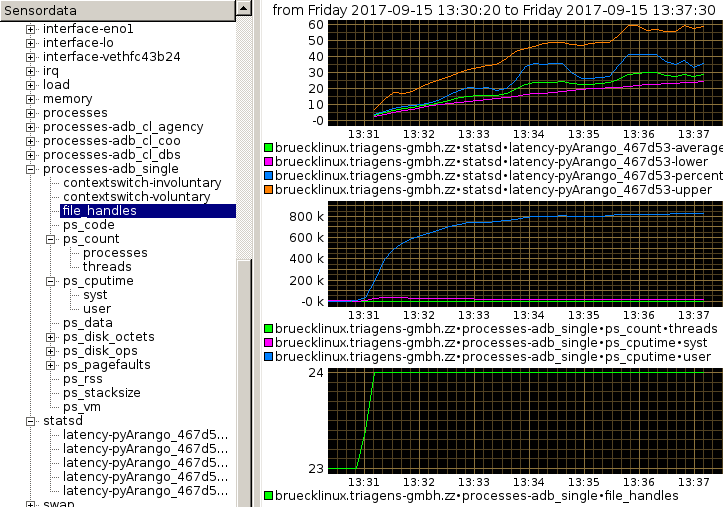
Under the \`statsd\` branch we find the values our AQL query emits. We create one graph with it.
To see the resource usage of the ArangoDB process we also add another graph for it, and a third graph that shows the number of file descriptors ArangoDB is using.
From inspecting the graphs, we see the query up to using 60ms which is not that bad, but its runtime behavior degrades over time – which is rather undesirable.
The blue line identifies the 95%-percentile, which is way below the brown line with the maximum reply time. This indicates that there are single replies that are much worse than the percentile – a behavior that one wouldn’t like to have at all.
All of the above is usually an indicator for a full collection scan happening since we only query one document, it may be found faster or slower, which is what makes the values bounce.
Taking a look at our code, we see that this aligns to the number of documents we fill into the \`test\`-collection.
Thus we take a closer look at the monitored query using [explain](https://www.arangodb.com/docs/stable/aql/execution-and-performance-explaining-queries.html):
```
Query string:
FOR doc IN test FILTER doc.count == @i - 1 RETURN doc
Execution plan:
Id NodeType Est. Comment
1 SingletonNode 1 * ROOT
2 EnumerateCollectionNode 100000 - FOR doc IN test /* full collection scan */
3 CalculationNode 100000 - LET #1 = (doc.`count` == 0) /* simple expression */ /* collections used: doc : test */
4 FilterNode 100000 - FILTER #1
5 ReturnNode 100000 - RETURN doc
Indexes used:
none
Optimization rules applied:
none
```
AHA! no index is used – this is why it worsens with the collection filling up.
### Fix it…
So we create an index in the setup phase of our test code: \`testCol.ensureHashIndex(\[‘count’\], sparse=False)\`
Once its there, explain will show us it’s going to be used:
```
Query string:
FOR doc IN test FILTER doc.count == @i - 1 RETURN doc
Execution plan:
Id NodeType Est. Comment
1 SingletonNode 1 * ROOT
6 IndexNode 1 - FOR doc IN test /* hash index scan */
5 ReturnNode 1 - RETURN doc
Indexes used:
By Type Collection Unique Sparse Selectivity Fields Ranges
6 hash test false false 100.00 % [ `count` ] (doc.`count` == 0)
Optimization rules applied:
Id RuleName
1 use-indexes
2 remove-filter-covered-by-index
3 remove-unnecessary-calculations-2
```
### Re-run test and analyze
and the values we measure show much better results:
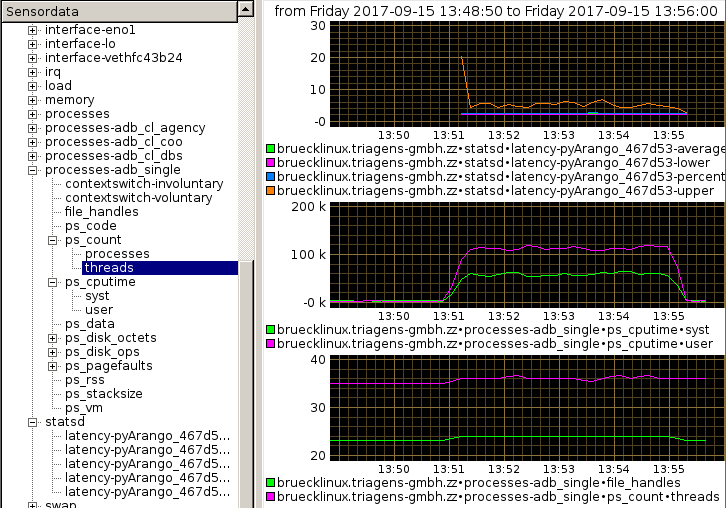
While the first run wasn’t finished yet after 7 minutes, the second run is already done in 4 minutes. We saw that the \`Thread count\` numbers weren’t in the range of the CPU time values at all, so we move it over to the file handle count graph.
Watching the reply times of the query from the first run, we can see worst reply times were around 60 ms. At the start we see the \`truncate\`-operation is giving us little slower values, but during the regular test run the maximum values are at around 5ms – which is perfectly acceptable.
We also can see the resource usage by the ArangoDB process is way better – 100k [jiffies](https://en.wikipedia.org/wiki/Jiffy_(time))compared to 900k jiffies in the first test run.
We also see that the system CPU time is 1/3rd of the total CPU, which means we do a lot of I/O (write new documents to disk) while mildly loading the machine with userspace calculations.
In the first run, the system CPU usage would be next to unmeasurable.
Learn how to speed up your AQL queries. Get A [Primer on Query Performance Optimization in ArangoDB](https://www.arangodb.com/arangodb-performance-course/)
### What’s next
In the next articles, we’re going to take a look at how to measure and[instrument transactions](https://blog.arangodb.com/blog/2017/09/performance-analysis-pyarango-inspecting-transactions) (Part II), and what to look at on clusters. We will also implement a user scenario to measure the possible capacity of a given system. Stay tuned!
[Twitter](https://twitter.com/intent/tweet?url=https://blog.arangodb.com/blog/2017/09/performance-analysis-using-pyarango) [LinkedIn](http://www.linkedin.com/shareArticle?mini=true&url=https://blog.arangodb.com/blog/2017/09/performance-analysis-using-pyarango) [Reddit](https://www.reddit.com/share?url=https://blog.arangodb.com/blog/2017/09/performance-analysis-using-pyarango) [Yahoo](https://plus.google.com/share?url=https://blog.arangodb.com/blog/2017/09/performance-analysis-using-pyarango%3Futm_medium%3Dsocial%26utm_source%3Dgoogle_plus)

September 21, 2017 , [Willi Goesgens](https://blog.arangodb.com/blog/author/willi-goesgens)
Willi is part of ArangoDB Core team. He primarily works on performance tuning, the release process of ArangoDB and helping the community with his broad experience.
### Leave a Comment
Tags
- [General](https://blog.arangodb.com/blog/topic/general)
- [Release](https://blog.arangodb.com/blog/topic/release)
- [Community](https://blog.arangodb.com/blog/topic/community)
- [Releases](https://blog.arangodb.com/blog/topic/releases)
- [Performance](https://blog.arangodb.com/blog/topic/performance)
- [Tutorial](https://blog.arangodb.com/blog/topic/tutorial)
- [Foxx](https://blog.arangodb.com/blog/topic/foxx)
- [AQL](https://blog.arangodb.com/blog/topic/aql)
- [API](https://blog.arangodb.com/blog/topic/api)
- [Newsletter](https://blog.arangodb.com/blog/topic/newsletter)
- [Cluster](https://blog.arangodb.com/blog/topic/cluster)
- [Graph](https://blog.arangodb.com/blog/topic/graph)
- [Graphs](https://blog.arangodb.com/blog/topic/graphs)
- [Documentation](https://blog.arangodb.com/blog/topic/documentation)
- [Javascript](https://blog.arangodb.com/blog/topic/javascript)
- [Query Language](https://blog.arangodb.com/blog/topic/query-language)
- [Architecture](https://blog.arangodb.com/blog/topic/architecture)
- [NoSQL](https://blog.arangodb.com/blog/topic/nosql)
- [Enterprise](https://blog.arangodb.com/blog/topic/enterprise)
- [Ruby](https://blog.arangodb.com/blog/topic/ruby)
- [RocksDB](https://blog.arangodb.com/blog/topic/rocksdb)
- [testing](https://blog.arangodb.com/blog/topic/testing)
- [ArangoML](https://blog.arangodb.com/blog/topic/arangoml)
- [Machine Learning](https://blog.arangodb.com/blog/topic/machine-learning)
- [Benchmark](https://blog.arangodb.com/blog/topic/benchmark)
- [Java](https://blog.arangodb.com/blog/topic/java)
- [driver](https://blog.arangodb.com/blog/topic/driver)
- [multi-model](https://blog.arangodb.com/blog/topic/multi-model)
- [geo](https://blog.arangodb.com/blog/topic/geo)
- [how to](https://blog.arangodb.com/blog/topic/how-to)
- [Drivers](https://blog.arangodb.com/blog/topic/drivers)
- [PHP](https://blog.arangodb.com/blog/topic/php)
- [Security](https://blog.arangodb.com/blog/topic/security)
- [nodejs](https://blog.arangodb.com/blog/topic/nodejs)
- [python](https://blog.arangodb.com/blog/topic/python)
- [ArangoSearch](https://blog.arangodb.com/blog/topic/arangosearch)
- [Kubernetes](https://blog.arangodb.com/blog/topic/kubernetes)
- [Presentation](https://blog.arangodb.com/blog/topic/presentation)
- [open-source](https://blog.arangodb.com/blog/topic/open-source)
- [Future-of-nosql](https://blog.arangodb.com/blog/topic/future-of-nosql)
- [GitHub](https://blog.arangodb.com/blog/topic/github)
- [ARM: Raspberry + Co.](https://blog.arangodb.com/blog/topic/arm-raspberry-co-)
- [Fraud Detection](https://blog.arangodb.com/blog/topic/fraud-detection)
- [Managed Service](https://blog.arangodb.com/blog/topic/managed-service)
- [arangosh](https://blog.arangodb.com/blog/topic/arangosh)
- [C++](https://blog.arangodb.com/blog/topic/c)
- [Cloud](https://blog.arangodb.com/blog/topic/cloud)
- [Conferences](https://blog.arangodb.com/blog/topic/conferences)
- [Data Science](https://blog.arangodb.com/blog/topic/data-science)
- [HTTP](https://blog.arangodb.com/blog/topic/http)
- [ML](https://blog.arangodb.com/blog/topic/ml)
- [Pregel](https://blog.arangodb.com/blog/topic/pregel)
- [Replication](https://blog.arangodb.com/blog/topic/replication)
- [WebUI](https://blog.arangodb.com/blog/topic/webui)
- [graph database](https://blog.arangodb.com/blog/topic/graph-database)
- [monitoring](https://blog.arangodb.com/blog/topic/monitoring)
- [pytorch](https://blog.arangodb.com/blog/topic/pytorch)
- [Application Server](https://blog.arangodb.com/blog/topic/application-server)
- [ArangoGraphML](https://blog.arangodb.com/blog/topic/arangographml)
- [Community Edition](https://blog.arangodb.com/blog/topic/community-edition)
- [Compliance](https://blog.arangodb.com/blog/topic/compliance)
- [Linux](https://blog.arangodb.com/blog/topic/linux)
- [Publication](https://blog.arangodb.com/blog/topic/publication)
- [Relational Database](https://blog.arangodb.com/blog/topic/relational-database)
- [SOC 2](https://blog.arangodb.com/blog/topic/soc-2)
- [Windows](https://blog.arangodb.com/blog/topic/windows)
- [licensing](https://blog.arangodb.com/blog/topic/licensing)
- [networkx](https://blog.arangodb.com/blog/topic/networkx)
- [storage](https://blog.arangodb.com/blog/topic/storage)
- [ARM](https://blog.arangodb.com/blog/topic/arm)
- [Alliances](https://blog.arangodb.com/blog/topic/alliances)
- [ArangoDB Cloud](https://blog.arangodb.com/blog/topic/arangodb-cloud)
- [ArangoSync](https://blog.arangodb.com/blog/topic/arangosync)
- [Arangograph](https://blog.arangodb.com/blog/topic/arangograph)
- [CNFC](https://blog.arangodb.com/blog/topic/cnfc)
- [DC/OS](https://blog.arangodb.com/blog/topic/dc-os)
- [DGL Adaptor](https://blog.arangodb.com/blog/topic/dgl-adaptor)
- [Data Loader](https://blog.arangodb.com/blog/topic/data-loader)
- [Dev Days 2021](https://blog.arangodb.com/blog/topic/dev-days-2021)
- [Developer Hub](https://blog.arangodb.com/blog/topic/developer-hub)
- [Funding Announcement](https://blog.arangodb.com/blog/topic/funding-announcement)
- [GO](https://blog.arangodb.com/blog/topic/go)
- [GenAI](https://blog.arangodb.com/blog/topic/genai)
- [Graph DB](https://blog.arangodb.com/blog/topic/graph-db)
- [Graph DBs](https://blog.arangodb.com/blog/topic/graph-dbs)
- [Graph Databases](https://blog.arangodb.com/blog/topic/graph-databases)
- [Graph Neural Networks](https://blog.arangodb.com/blog/topic/graph-neural-networks)
- [GraphDB](https://blog.arangodb.com/blog/topic/graphdb)
- [Inside ArangoDB](https://blog.arangodb.com/blog/topic/inside-arangodb)
- [Intel](https://blog.arangodb.com/blog/topic/intel)
- [Intel PyG](https://blog.arangodb.com/blog/topic/intel-pyg)
- [Intel Xeon CPU](https://blog.arangodb.com/blog/topic/intel-xeon-cpu)
- [KG](https://blog.arangodb.com/blog/topic/kg)
- [Knowledge Graphs](https://blog.arangodb.com/blog/topic/knowledge-graphs)
- [LLM](https://blog.arangodb.com/blog/topic/llm)
- [Large Language Models](https://blog.arangodb.com/blog/topic/large-language-models)
- [Migrate to Graph](https://blog.arangodb.com/blog/topic/migrate-to-graph)
- [NetworkX Adaptor](https://blog.arangodb.com/blog/topic/networkx-adaptor)
- [Oasis](https://blog.arangodb.com/blog/topic/oasis)
- [Partners](https://blog.arangodb.com/blog/topic/partners)
- [PyG](https://blog.arangodb.com/blog/topic/pyg)
- [PyTorch Geometric](https://blog.arangodb.com/blog/topic/pytorch-geometric)
- [RDF](https://blog.arangodb.com/blog/topic/rdf)
- [Series B](https://blog.arangodb.com/blog/topic/series-b)
- [adapter](https://blog.arangodb.com/blog/topic/adapter)
- [analytics](https://blog.arangodb.com/blog/topic/analytics)
- [analyzers](https://blog.arangodb.com/blog/topic/analyzers)
- [arangopipe](https://blog.arangodb.com/blog/topic/arangopipe)
- [atomics](https://blog.arangodb.com/blog/topic/atomics)
- [aws](https://blog.arangodb.com/blog/topic/aws)
- [collaboration](https://blog.arangodb.com/blog/topic/collaboration)
- [concurrency](https://blog.arangodb.com/blog/topic/concurrency)
- [dev days](https://blog.arangodb.com/blog/topic/dev-days)
- [fuzzy search](https://blog.arangodb.com/blog/topic/fuzzy-search)
- [graphsage](https://blog.arangodb.com/blog/topic/graphsage)
- [licence](https://blog.arangodb.com/blog/topic/licence)
- [memory model](https://blog.arangodb.com/blog/topic/memory-model)
- [plugin](https://blog.arangodb.com/blog/topic/plugin)
- [preprocessing](https://blog.arangodb.com/blog/topic/preprocessing)
- [recommendation](https://blog.arangodb.com/blog/topic/recommendation)
- [resource description framework](https://blog.arangodb.com/blog/topic/resource-description-framework)
- [semantic web](https://blog.arangodb.com/blog/topic/semantic-web)
- [torch](https://blog.arangodb.com/blog/topic/torch)
- [turtle](https://blog.arangodb.com/blog/topic/turtle)
- [x86](https://blog.arangodb.com/blog/topic/x86)
- [— Relational Database](https://blog.arangodb.com/blog/topic/-relational-database)
[](https://arango.ai)
ArangoGraph Insights Platform Accelerate application innovation and performance with our next-generation graph data and analytics platform.
-
-
-
-
-
#### Quick Links
- [Quick Start](https://docs.arangodb.com/3.11/)
- [Roadmap](https://arangodb.com/roadmap/)
- [Language Drivers](https://docs.arangodb.com/3.11/develop/drivers/)
- [Case Studies](https://arangodb.com/solutions/solutions-customers/#all)
- [BI Connectors](https://arangodb.com/community-driven/bi-connector-arangodb/)
- [Certification Exam](https://arangodb.com/learn/certification/)
#### Info
- [Community](https://arangodb.com/community/)
- [Events](https://arangodb.com/events)
- [Online Meetup](https://www.meetup.com/online-ArangoDB-meetup/)
- [Logo/Resources](https://arangodb.com/resources/logos/)
- [Stackoverflow](https://stackoverflow.com/questions/tagged/arangodb)
- [Slack](https://join.slack.com/t/arangodb-community/shared_invite/zt-2d4p43cma-flyf72j9a9wq4A2OtuMFkA)
#### About Us
- [About Us](https://arangodb.com/about-us/)
- [Jobs](https://arangodb.applytojob.com/apply)
- [Imprint](https://arangodb.com/imprint/)
- [Contact Us](https://arangodb.com/contact/)
- [News](https://arangodb.com/news/)
- [Google Groups](https://groups.google.com/g/arangodb)
#### Stay In Touch
Keep up with the latest news from the ArangoDB
©2023 ArangoDB. All Rights Reserved.
[Terms & Conditions](https://cloud.arangodb.com/terms-and-conditions)|[Our Privacy Policy](https://cloud.arangodb.com/privacy-policy)
